Oud 101: Understanding Pakistan’s Most Beloved Fragrance Note

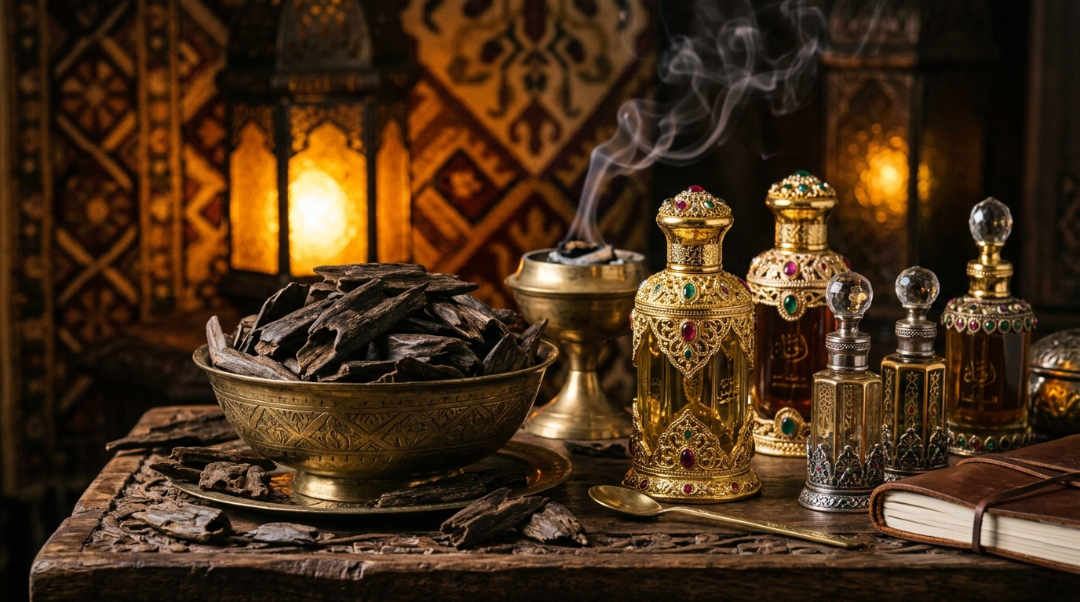
If you grew up in a Pakistani household, you know what oud smells like before you know what it’s called. It’s the smoke that rises from dhukhni at family gatherings. It’s what your mother’s good abayas smell like. It’s the base of half the attars your father still wears.
Oud is not a trend in Pakistan. It’s embedded in the culture in a way that Western fragrance markets are only now beginning to understand — and inevitably, commercialise.
But what is oud, exactly? Why does it smell so different from bottle to bottle? And how do you tell quality from imitation? Here’s the full picture.
What Oud Actually Is
Oud (also spelled aoud or oudh, Arabic: عود) is derived from the resin of Aquilaria trees, native to South and Southeast Asia — India, Bangladesh, Vietnam, Cambodia, Malaysia, and parts of China. The resin forms only when the tree is infected by a specific mould (Phialophora parasitica). In response to the infection, the tree produces a dark, aromatic resin to defend itself. This resinous heartwood is what we call oud.
Natural oud is one of the most expensive raw materials in the fragrance industry by weight, often exceeding the price of gold. A kilogram of genuine high-grade Hindi oud can cost hundreds of thousands of rupees. Which immediately explains why most oud-marketed products don’t contain what they imply.
Why Oud Smells Different Every Time
The variation in oud scent between products is not just a matter of concentration. It comes from:
Geographic origin. Hindi oud (from India) tends to be animalic, leathery, and intensely complex — the kind that smells almost medicinal to the uninitiated. Cambodian (Cambodi) oud is smoother, sweeter, and more accessible. Vietnamese oud is often described as clean and woody. Each region’s soil, climate, and fungal strains produce chemically distinct resin compositions.
Wild vs cultivated. Wild oud from naturally infected trees produces a more complex aromatic profile than plantation-grown oud (where infection is artificially induced to scale production). The difference is chemically measurable and experientially significant.
Distillation method. Hydro-distillation vs steam distillation produces different aromatic profiles from the same wood. Older, slower distillation methods preserve more of the complex compounds. Faster industrial distillation produces a cleaner but less nuanced output.
Synthetic vs natural. Lab-created oud molecules (like Oud-Base or various ISO E Super derivatives) are used in most mass-market fragrances. They approximate certain facets of oud but flatten the complexity. They’re not fraudulent — many beautiful fragrances use them intentionally — but they’re a different thing.
The Pakistani Oud Tradition
Pakistan sits at a junction of Mughal, Persian, and South Asian attar traditions. The attar format — pure oil-based fragrance without alcohol — has been the traditional vehicle for oud here. Pakistani and Indian attar makers have historically sourced raw oud from Bangladesh and Assam, which produces the Hindi-style animalic profile most familiar to local palates.
The shift toward spray-format Western-style perfumes over the last two decades has changed what most people experience as oud. Spray formats require alcohol as a carrier, which means the oud concentration is diluted significantly compared to concentrated attar. The experience is different — lighter projection, faster fade.
Neither is better. They serve different contexts. Attar is still unmatched for longevity and richness on skin.
How to Evaluate Oud Quality
If you’re buying attar or oud oil specifically (not just a perfume containing oud notes):
Smell the drydown. Real oud evolves on skin over hours. It opens with an initial burst, settles into a middle character, and has a base that lingers differently. Synthetic oud notes tend to smell the same at hour one and hour four.
Price is a signal. Not proof, but a signal. Genuinely natural Hindi or Cambodian oud at a suspiciously low price is almost certainly adulterated or synthetic. The raw material cost makes it impossible otherwise.
Ask about origin. Reputable attar sellers know their suppliers and can tell you the geographic source. Vague answers about “premium oud” without origin details usually mean blended or synthetic.
Test on skin, not paper. Oud is a living compound that interacts with your skin chemistry. The strip tells you almost nothing useful.
Wearing Oud in Pakistan’s Climate
Heavy heat amplifies oud’s projection significantly. What feels appropriate in a cool room becomes overwhelming at 38 degrees. Apply oud attars sparingly — a small dab on the wrist, inner elbow, or behind the ear is enough. In summer, it will project further than you expect.
Reserve heavy oud for evening events, cooler months, or air-conditioned environments. For daytime or outdoor summer wear, oud blends with citrus or green notes modulate the intensity appropriately.